


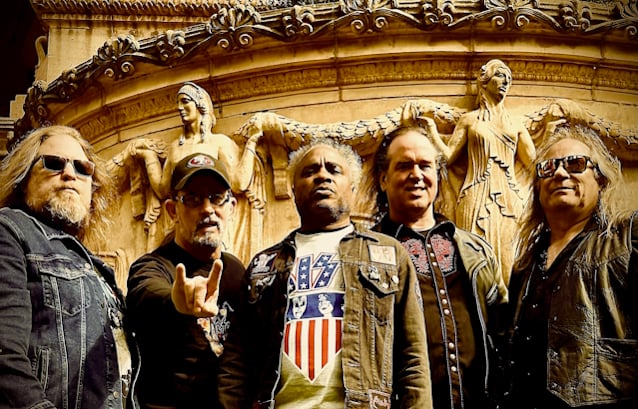
Ex-EXODUS Guitarist RICK HUNOLT And Ex-HEATHEN Guitarist DOUG PIERCY Re-Ignite Their Love For Old-School Thrash In NEFARIOUS
August 5, 2025By David E. Gehlke
The San Francisco Bay Area thrash scene is more of a community than anything. The competition that fueled thrash's legendary albums in the 1980s has since evolved into a larger block of individuals who not only keep the style alive, but play on each other's records, perform benefits together and hop up on stage for the occasional guest appearance. Such good vibes led to the formation of NEFARIOUS, an all-star California thrash ensemble featuring Katon W. De Pena (HIRAX) on vocals, Rick Hunolt (EXODUS, DIEHUMANE) and Doug Piercy (HEATHEN, ANVIL CHORUS) on guitar, Tom Gears (BLIND ILLUSION, ANCIENT MARINER) on bass and Will Carroll (DEATH ANGEL) on drums, who have since released their debut LP, "Addicted To Power".
The outfit is perhaps most notable for the return of Hunolt after a 20-year recording absence from thrash. The former EXODUS guitarist has hopped onstage with his former bandmates on a number of occasions since his 2005 departure, but NEFARIOUS affords Hunolt the opportunity to reapply his trademark thrash riffing alongside Piercy, who, since his departure from HEATHEN in 1992, has popped up with BLIND ILLUSION and has gotten into studio production. It all adds up to a fun, no-thrills thrash record, of which Hunolt and Piercy were more than happy to discuss with BLABBERMOUTH. (Note: Piercy joined the conversation halfway through.)
Blabbermouth: You haven't done a pure thrash record in over 20 years. Why now? Why NEFARIOUS?
Rick: "As I've said a million times, when I left EXODUS, I had to leave and get my head right. I had two babies who needed a dad. I stepped away, and I didn't play very much for years. I got a call from Steev [Esquivel] from SKINLAB about this band, DIEHUMANE, that needed a guitar player. I was at the point where I was really missing music. It's in my blood; it always has been, ever since I was a little kid. Long story short, I committed to DIEHUMANE. They live in Texas, and I live in the Bay Area in northern California. It's hard for us to get together. Our singer is an eighth-grade English teacher, so he doesn't have a lot of time, and it's super difficult. The logistics don't match up at the moment. We wanted to do shows and all this stuff. So far, it hasn't panned out. We have new music coming with some great collaborations with some pretty big names. The music is diabolical; it's really crazy music. After that, I started getting my chops back. I'm like, 'I miss thrash so much.' I still go to shows all the time. They're all my best friends. I got a call from Doug, saying, 'Dude. I got this project going. This is what's going on. You want to do some solos?' At first, I was going to do solos, and it led to another thing where we started talking. We've been great friends for 40 years: 'Why don't we do something together and put together a band?' We got together a lineup that's killer. Everything is working out fabulously, and the music is fun to play."
Blabbermouth: You mentioned losing your chops. You have still found a way to hop up onstage with EXODUS now and then.
Rick: "I'll get a call from Gary [Holt], once or twice a year. I filled in for him a few times in Europe for a few months, and it was fabulous. We just did the 40th anniversary [for 'Bonded By Blood'] at the UC Theater in Berkeley, which was badass. I had a blast. Everybody's completely supportive. Nowadays, all I do is write music and play with Doug. We have lots of music happening and more is on the way."
Blabbermouth: Is this all new material you're using for NEFARIOUS? Or did you bring anything over from EXODUS?
Rick: "If you come from the old-school, the old thrash scene: thrash hasn't changed that much. The only thing that has changed is that we have more refined gear these days for writing in the studio and all this digital stuff. I don't use it live. But not much has changed. When Doug and I get together and play music, that's what naturally happens. We naturally have an old-school vibe — the harmonies and the fast, melodic stuff, the crunch. As far as guitars go, thrash tones haven't changed in 40 years. In my point of view, they've gotten quieter because the gear is state of the art."
Blabbermouth: Would you say, then, that is an old-school approach for old-school music?
Rick: "It's not going out and saying, 'Hey, let's write some old-school music.' Dude, this is just what happens when we play because we are old-school. It would be like if I went to write a FIVE FINGER DEATH PUNCH riff. I couldn't do it because I'm an old-school thrasher. When I set up my drum machine and I hit a thrash beat and I start going, that's what happens. It's in my blood."
Blabbermouth: Can you explain the production job for "Addicted To Power"? It feels like that is old-school as well.
Rick: "We used tube amps, for one. We didn't go in there and layer a whole bunch of rhythms. We got the old-school sound that we are known for and that we get naturally when we pick up a guitar, and we went with it. We didn't have the real clicky drums; we wanted a proper thrash mix. Let me tell you: That's not an easy task, especially when you have a bass player as good as ours. He's a monster. And he demands to be heard. Not him personally, but his performance demands to be heard. What you basically end up with is you have these instruments and you're trying to put them all together so you can hear everything, so we wanted to keep it more simple, more raw."
Doug: "It's just raw speaker cabinets, guitar strings, and our hands. [Laughs] It's pretty much that."
Rick: "When you go to mix an album like this and try to keep it old-school, and when you have a bass player like Tom, whose performance is so good, he demands to be heard. There's no burying him in the mix. You have to build around his low-end frequencies and put the guitars where they belong. And the drums, too. You can't just throw in a crunchy-ass guitar tone and put it there. It doesn't work that way. Everyone has their place."
Doug: "Finding the frequency area is critical."
Rick: "Absolutely. Will's an old-school dude, too. He's a beast. He's very particular about his drum sound. He doesn't want his drums to sound all clicky. He wants them to sound like real drums. We go back and forth until we're happy, until everyone is happy, then it's good."
Blabbermouth: Doug, Rick touched upon this earlier, and it may be worth getting your perspective: When you sit down to write, are thrash riffs usually the first things that come out?
Doug: "In a single word, yes. [Laughs] It's kind of funny. When Rick and I sit down and start playing, it's like we both have the same approach to the strings, the muting, the attack — everything. It's funny: We come from the same area, the whole HEATHEN and EXODUS thing is pretty close. It's all Bay Area. It's an unspoken kind of understanding of how we developed. It's in the DNA of the Bay Area. I don't know, but we don't have to talk much. I don't have to say, 'Bro. You need to use your palm on your bridge and don't press so hard on the Floyd Rose [tremolo] so it goes sharp.' And 'Bro. You need to be clean with picking.' That doesn't have to be said. Sometimes Rick goes [mimic riffs] and we'll play it."
Rick: "That, in its own right, makes it so much fun. It's a Bay Area thing, but it's also a style. Old-school thrash and the way we approach the instrument of the guitar, it's a style. You're going to find this weird, but it's like the rave scene, and I'm an old-school raver from back in the day. We have a dance, like house music, that has a certain style that we do here. It's the same thing. It's our approach to the guitar. It's awesome."
Blabbermouth: And how does Katon fit into all of this? Does he usually come in at the end?
Doug: "Yeah, pretty much. He comes in once all the riffs are figured out. It starts when Rick or I have a riff, and we'll send them to each other. Then we'll get together and record them into a click track in Pro Tools. Then you can cut and paste and arrange songs quickly and determine the arrangement. This is something I've been doing a lot within the last couple of years. We didn't have a Pro Tools rig at home. Now I have my own home studio, so it's a lot different from how it used to be. Then I figure out how to take Rick's riff and the stuff I come up with, and mold it together. We're playing to the metronome on the click, and we'll figure out the arrangement. After we work with Will, Katon will drive up from L.A., so Katon and I will talk about, 'This is where the verse goes. Here's the lyrics.' I'll do a guide track of me screaming and doing a heinous attempt at vocals. [Laughs] We usually keep them; the tracks are still there, but they're buried. And Katon takes it from there."
Rick: "We give him one hundred percent leeway. He can do whatever he wants, and if you notice, his style and approach to 'Addicted To Power' is different than HIRAX. A lot of people are talking about it. It's pretty crazy to watch because we gave him the freedom to do whatever he felt like. He came up with some great stuff. I think it's the best stuff he's ever sung, honestly."
Blabbermouth: Given everyone's location and other bands, what's the live show approach going to be?
Rick: "We're going to do as many shows as we can. We have to deal with DEATH ANGEL and HIRAX's schedules. We're going to play as many shows as we possibly can, get out on tour when everyone can do it. That's our goal."
Blabbermouth: What is your stance on whether thrash has already been perfected from either a songwriting and tone perspective?
Rick: "It's all about the songs. Now, for all of us thrashers, it's about getting up there and writing the best songs that we can."
Doug: "You need to figure out what sounds good to become a song. It's simple production techniques, but if you're producing something and trying to make it good, you'll recognize that particular riff or chord progression lends itself well to a melodic solo area or maybe a dual harmony area or something like that. Whereas a simplified version of the main riff oftentimes lends itself well to a simple vocal verse. Sometimes, you can take the same riff that's simplified and make it the full, complicated version and make that the chorus. That's an old-school technique."


 Prev
Prev 